
How to Learn Artificial Intelligence from Scratch: A Beginner’s Guide (2026)
Artificial Intelligence (AI) is transforming the world. From smart assistants and automated businesses to content creation and data analysis, AI is becoming an important part of everyday life.
Are you interested in learning Artificial Intelligence but don’t know where to start? Don’t worry! You don’t need to be a programmer, technology expert, or mathematics genius to begin your AI learning journey.
In this beginner-friendly guide, you will discover how to learn AI from scratch, which tools to explore, what skills to develop, and how to practise AI in real-life situations.
1. Understand What Artificial Intelligence Is
Artificial Intelligence is a field of technology that enables computers to perform tasks that normally require human intelligence.
These tasks include understanding language, recognising images, analysing information, generating content, and making predictions.
Some common examples of AI include:
- ChatGPT for conversations and content creation.
- Google Gemini for research and learning.
- AI image generators for creative designs.
- AI video tools for video production.
- AI automation tools for repetitive tasks.
Understanding these basic concepts is the first step toward learning Artificial Intelligence.
2. Start with Beginner-Friendly AI Tools
One of the easiest ways to learn AI is by using practical AI applications.
Start with these popular tools:
ChatGPT: Explore writing, brainstorming, learning, and problem-solving.
Google Gemini: Practise research, explanations, and everyday productivity tasks.
Canva AI: Experiment with graphic design and visual content creation.
Perplexity AI: Explore research questions and discover supporting sources.
Microsoft Copilot: Learn how AI can support everyday productivity.
You do not need to learn every tool at once. Choose one tool and practise regularly.
3. Learn the Basics of Prompt Engineering
Prompt engineering means giving clear instructions to an AI tool to get useful results.
For example, instead of writing:
“Write about marketing.”
Try this:
“Act as a digital marketing expert. Write a beginner-friendly 300-word guide explaining five effective digital marketing strategies for small businesses.”
A good prompt usually explains:
- Your goal.
- The role you want AI to perform.
- The information you need.
- Your preferred format.
- Your target audience.
Learning how to write better prompts can help you use AI tools more effectively.
4. Explore Different AI Skills
Once you understand the basics, explore different areas of Artificial Intelligence.
AI Content Creation: Learn to generate blog ideas, articles, captions, and marketing content.
AI Image Generation: Explore how AI can create illustrations, promotional graphics, and creative visuals.
AI Video Creation: Discover tools that help generate videos, subtitles, and promotional content.
AI Automation: Learn how to automate repetitive tasks and connect different applications.
AI for Business: Understand how AI can support customer communication, marketing, research, and productivity.
Choose skills that match your interests and career goals.
5. Practise AI with Real-Life Projects
Practical experience is one of the most important parts of learning AI.
Try completing these beginner projects:
- Create a professional email using ChatGPT.
- Design a social media poster using Canva AI.
- Generate a blog outline using an AI assistant.
- Research a topic using an AI research tool.
- Create a simple promotional video using an AI video editor.
These projects help you understand how AI can solve everyday problems.
Always review AI-generated information before using it, because AI tools can sometimes produce inaccurate results.
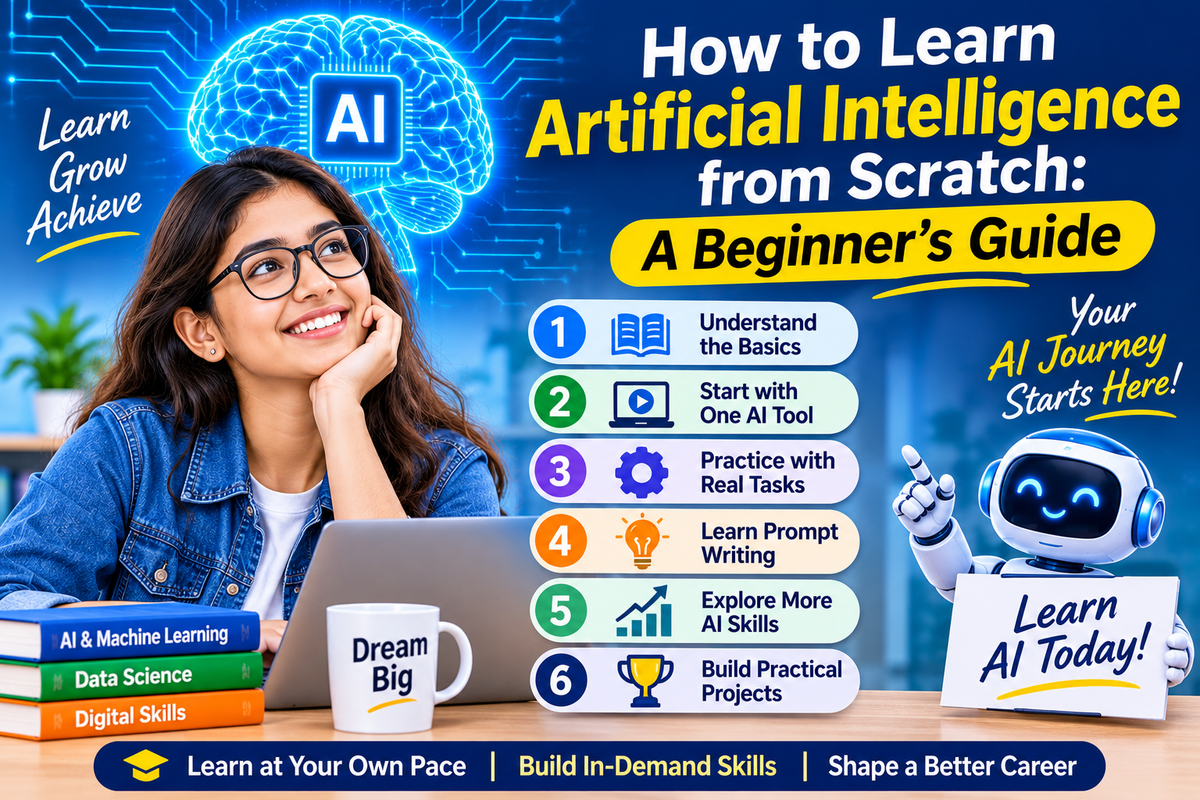
6. Follow a Simple 30-Day AI Learning Roadmap
Here is a practical learning plan for beginners.
Week 1: Understand AI Basics
- Learn what Artificial Intelligence means.
- Explore common AI applications.
- Understand the difference between AI and traditional software.
- Try a beginner-friendly AI assistant.
Week 2: Learn Popular AI Tools
- Practise using ChatGPT.
- Explore Google Gemini.
- Experiment with Canva AI.
- Learn basic prompt writing.
Week 3: Develop Practical Skills
- Create content using AI.
- Generate images.
- Explore AI research tools.
- Try simple video editing.
Week 4: Build Small Projects
- Create a blog article.
- Design a promotional poster.
- Prepare a social media campaign.
- Build a small personal AI project.
By following this roadmap, you can develop a foundation in AI and identify which areas you want to explore further.
7. Do You Need Coding or Mathematics to Learn AI?
No. You can start using many AI tools without knowing programming or advanced mathematics.
However, if your goal is to become a machine learning engineer, AI developer, or data scientist, you will eventually need to study subjects such as Python programming, statistics, linear algebra, and machine learning.
Start with practical AI applications and gradually move towards technical subjects if they match your career goals.
8. Benefits of Learning Artificial Intelligence
Learning AI can help you:
- Improve everyday productivity.
- Develop valuable digital skills.
- Support creative projects.
- Explore business opportunities.
- Understand modern technology.
- Prepare for technology-related career paths.
AI does not guarantee a job or income, but practical AI knowledge can be a valuable addition to your existing skills.
Frequently Asked Questions (FAQs)
1. Can I learn AI from scratch without coding?
Yes. Many AI applications are designed for beginners and can be used without programming knowledge.
2. How long does it take to learn basic AI skills?
With regular practice, you can develop basic familiarity with AI tools in a few weeks. Advanced AI development requires much more study and practice.
3. Which AI tool should beginners learn first?
ChatGPT or Google Gemini can be good starting points because they allow beginners to explore AI through simple conversations.
4. Are there free AI courses for beginners?
Many learning platforms and AI providers offer free introductory learning resources. Check their current course details and access conditions.
5. Can students and business owners benefit from AI?
Yes. Students can use AI for learning and research, while business owners can explore content creation, marketing, customer communication, and automation.
Conclusion: Start Your AI Learning Journey Today
Artificial Intelligence is creating new ways to learn, work, and solve problems. The best way to understand AI is to start small, explore beginner-friendly tools, practise regularly, and gradually develop practical skills.
You do not need to master everything in one day. Choose one AI tool, complete your first project, and keep improving.
Your AI journey starts with one simple step. Learn Today. Lead Tomorrow!